


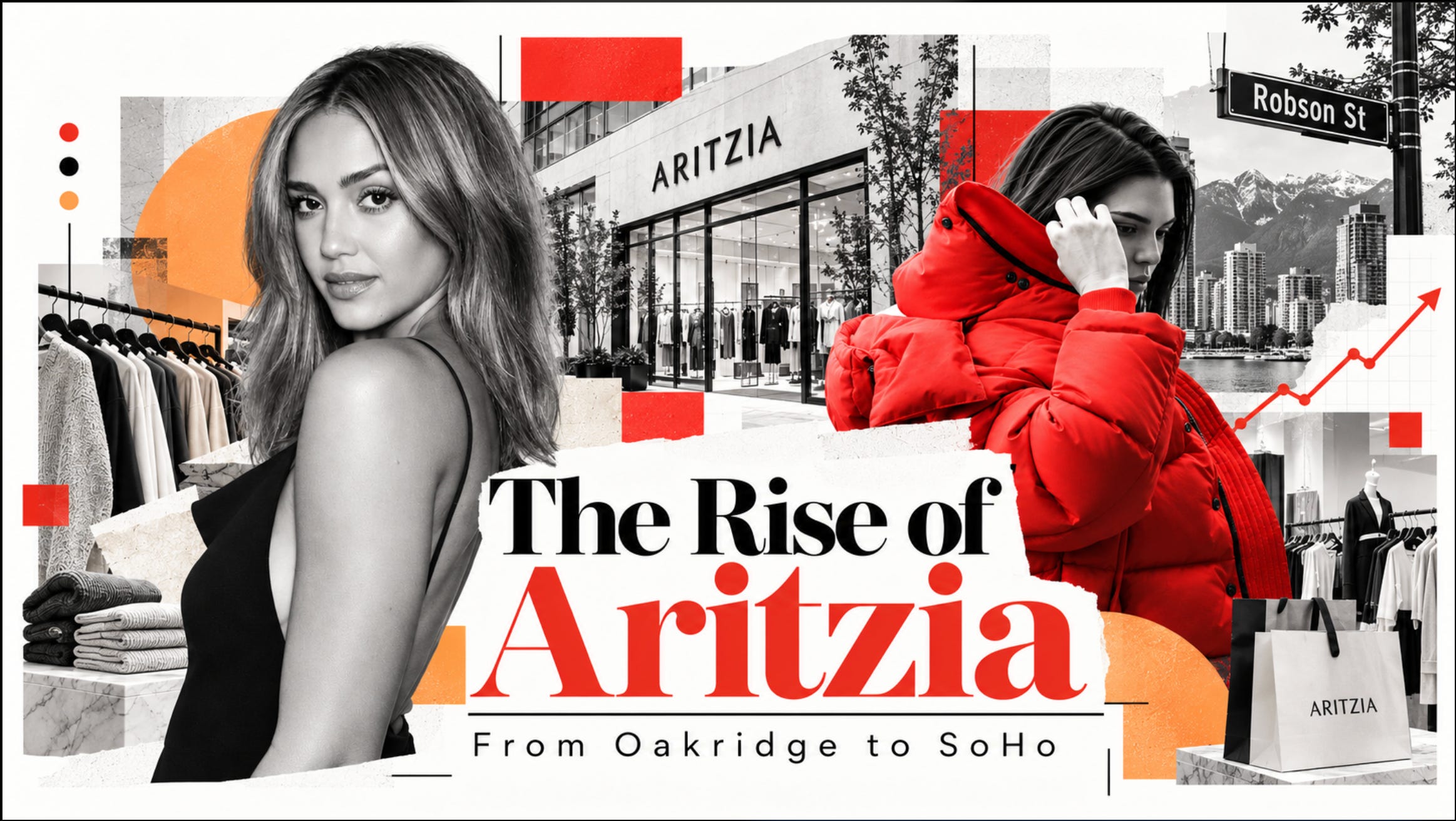
I think that most people in Vancouver know about Aritzia and how it started here (and if you didn’t, now you do), but I don’t think most of us have stopped to think about what it has become.
It all started 40 years ago, in 1984, when Brian Hill opened the first standalone Aritzia retail boutique at Oakridge Centre. Fast forward to 2026 and the company is one of the biggest homegrown fashion retailers Canada has ever produced generating over $3.7 billion in revenue and this year it’s expected to do nearly $5 billion.
What may come as a surprise to some is that most of the growth is now coming from America, now Aritzia’s largest market. In its latest quarter alone, U.S. revenue jumped 60%, that accounts for roughly two-thirds of the company’s sales.
It went from humble roots in Vancouver’s Oakridge Mall into an American fashion phenomenon. That’s not only a remarkable Vancouver story, that’s a remarkable Canadian story.
It all Started at Oakridge
The Hill family was already in retail, prior to starting Aritzia, going back to the the family-owned Hills of Kerrisdale, which still has several locations today. But Brian Hill saw an opportunity for something different. Better clothes, better stores, and a shopping experience that felt more elevated than your typical mall retailer.
Vancouver has more stories worth telling.
Get the next one in your inbox. Always free.
The companies, culture, people and ideas shaping our city. Independent perspectives, interesting discoveries and a little Vancouver pride. Delivered free to your inbox.
Get the next story free
Free to read. No payment required.
Then came one of the decisions that would become central to its success. Instead of simply selling other companies clothes, Aritzia began to build brands of its own. Babaton arrived in 1994, Tna a decade later in 2004. Shortly after they created Wilfred in 2007 and later Sunday Best, Denim Forum and the Super Puff.
Think about it, these aren’t independent companies that Aritzia happens to carry in-store. They created them, own them, design the clothing and control the entire customer experience. Everything ultimately flows back to the same company.
By 1999, Aritzia had expanded across Canada. Then in the 2000’s it set it sights on the United States.
America was Always the Prize
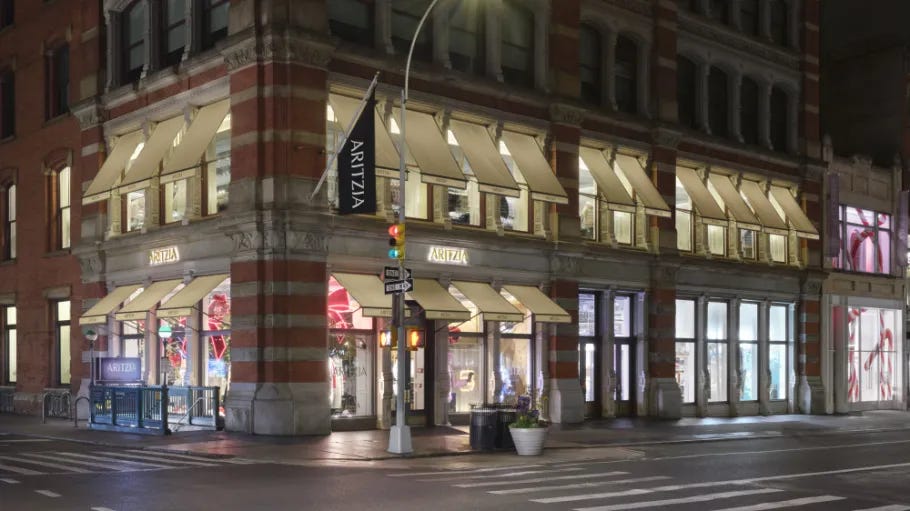
Aritzia opened its first U.S. location in 2006, followed six years later by a flagship in New York City’s SoHo neighbourhood.
There is a great quote from Aritzia’s then-CMO in a 2014 Fashionista interview that gives you a sense of how the company was thinking: “We don’t want to be known as a Canadian brand.” He quickly added that they were proud to be Canadian. They just weren’t going to lead with it.
That might hurt our Canadian pride a little, but strategically it makes sense. Aritzia wanted to become a fashion brand, not just a Canadian fashion brand. And I think to be a successful brand of this magnitude, that’s the mantra you have to carry.
When Aritzia became famous
Later the company started making a much more deliberate push into American media and celebrity culture. Taylor Swift was wearing Aritzia. So was Jennifer Lopez, Jessica Alba and many others.
In 2017, Meghan Markle appeared at the Invictus Games wearing a burgundy Wilfred dress. This was right at peak “Who is Prince Harry dating?” insanity, and the dress instantly sold out. They couldn’t keep it stocked.
Then came the Super Puff. Aritzia launched the jacket in 2017, but its defining pop-culture moment came the following year when Kendall Jenner appeared in a bright red version as part of a campaign. She was reportedly paid more than $1 million for two Instagram posts.
Shortly after, Bella Hadid, Ariana Grande, Hailey Bieber and other celebrities were all wearing Aritzia and they do so to this day.
The company itself disclosed in 2018 that it had dressed more than 50 high-profile people, including Kylie Jenner, Karlie Kloss, Jessica Alba and Meghan Markle.
This wasn’t accidental anymore. Celebrity placement and social media had become part of the growth strategy, and Aritzia rode the wave before it became overly saturated.

In 2023, the story came back to B.C. in a pretty perfect way when Pamela Anderson became the face of a Babaton campaign. One of B.C.’s most recognizable global celebrities selling one of B.C.’s most successful global brands. A match made in heaven.
The Sales Numbers Exploded
Aritzia went public in 2016, but the acceleration over the last few years has been something else.
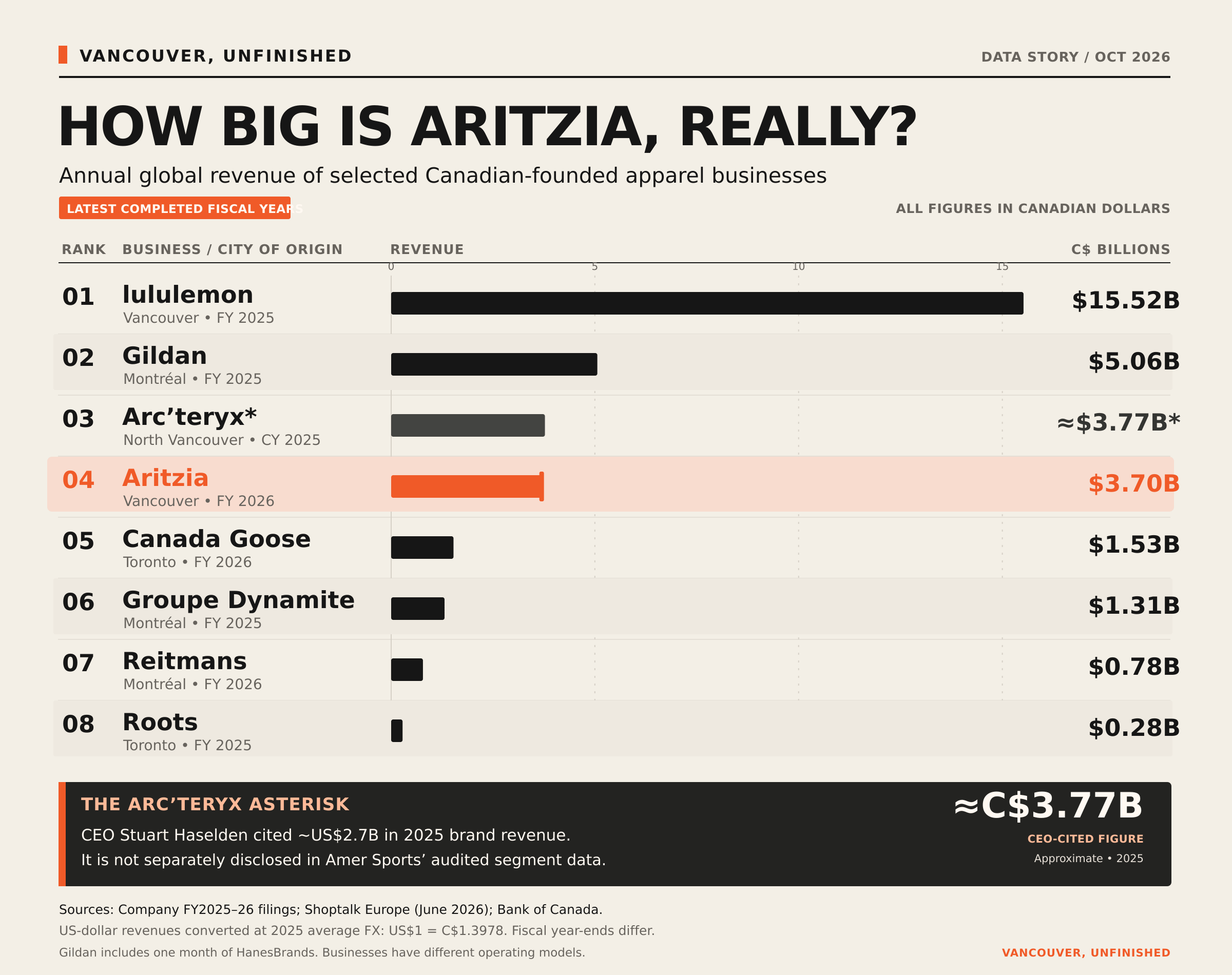
In fiscal 2026 alone the net income jumped 84 per cent to roughly $382 million. And overall sales are projected to hit nearly $5 billion this fiscal. That would put Artizia right up there with Gildan and with Arcteryx. 3 Vancouver based brands in the top 5, that’s impressive and neither of those brands appear to be slowing down.
By comparison, Canada Goose generated roughly $1.5 billion last year. That gap surprised me. For years I thought of Canada Goose was the larger global Canadian fashion company (outside of lululemon of coures). It certainly had the bigger international profile. I was so very wrong.
The Risk of Getting This Big
There is one question hanging over all this growth and that is, can Aritzia get this big without losing some of what made people obsessed with it in the first place?
Spend enough time around longtime customers and you’ll hear the complaints. Older coats felt heavier. Some staples were better made. There’s more polyester. The clothes don’t always feel as distinct as they once did.
That’s anecdotal, not proof of some company-wide collapse in quality, but the criticism is common enough that it’s worth paying attention to. It’s also almost what happens when apparel companies begin to scale. You see similar chatter around KITH and ALD these days and they are much smaller than Aritzia.
With roughly two-thirds of Aritzia’s sales now coming from the U.S. it represents the biggest opportunity for the brand. While growth in Canada remains solid.
Can Aritzia become a global fashion giant without sacrificingthe things that made Aritzia feel like Aritzia? It’s almost damn near impossible to scale without some loss in quality. Only time will tell.
From Tna to Reigning Champ
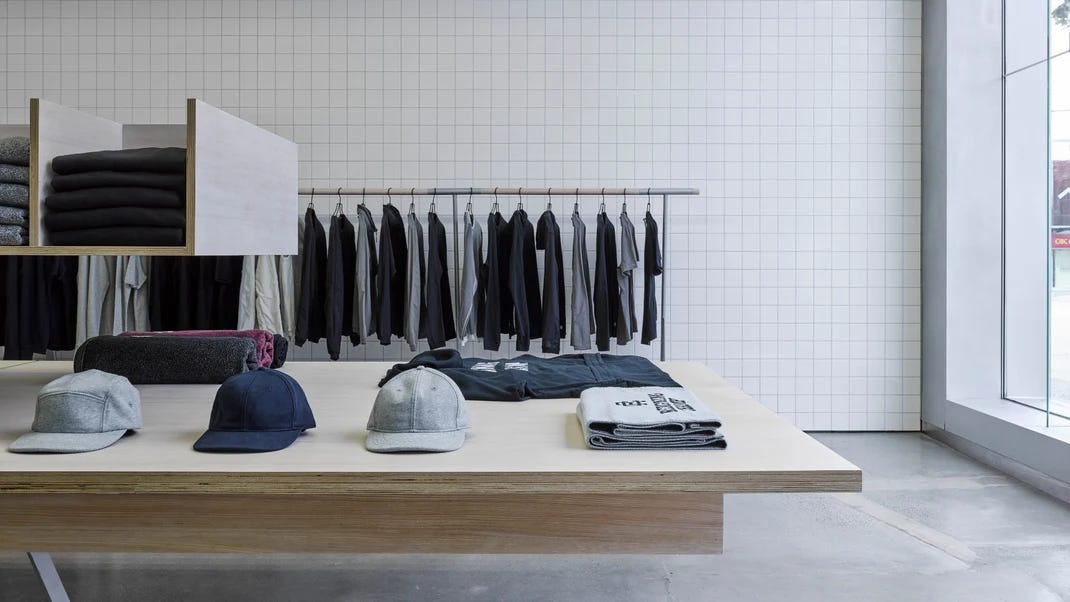
Aritzia has mostly grown by creating brands internally, but in 2021 they decided to acquire another made in Vancouver apparel company.
In June of 2021 they acquired a 75 per cent stake in Reigning Champ, in a deal that valued the business at about $63 million. Two years later, Aritzia bought the rest and now fully own the brand.
Reigning Champ is much smaller when compared with Aritzia’s women’s business, but the acquisition is interesting because it gives the company something it never really had before: a legitimate foothold in menswear and who knows over time it could become as similar story of growth.
The Jennifer Wong story might be just as good
There is another part of Aritzia’s rise that I love and it’s extremely rare these days.
Jennifer Wong has been with the company for almost 40 years. She started working there long before Aritzia became Aritzia as we know it today and eventually worked her way up to president and COO and 2022, Brian Hill stepped aside as CEO and Wong took over.
Since then, Aritzia’s revenue has gone from around $1.5 billion to $3.7 billion, the U.S. has overtaken Canada, and the company now expects to approach $5 billion this year.
There are plenty of companies where the founder leaving marks the end of an era. At Aritzia, it seems to be the beginning of another one.
From Oakridge to SoHo
This wasn’t a startup that appeared out of nowhere, raised a pile of money and suddenly became famous. The first store opened in 1984, Aritzia didn’t enter the U.S. until 2006 and it didn’t go public until 2016.
More than four decades later, the company is still accelerating.
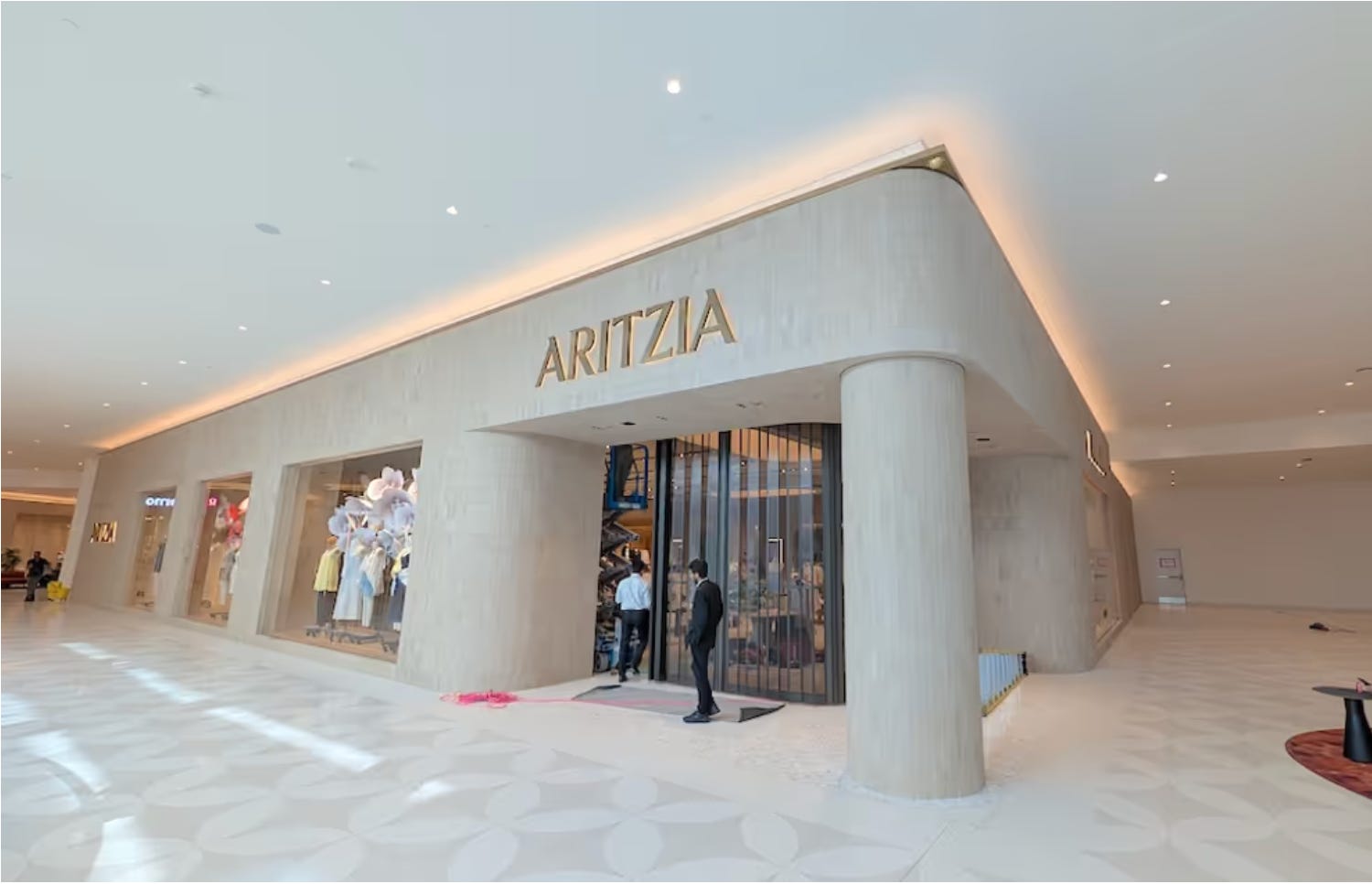
And fittingly, Aritzia has returned to Oakridge with a new flagship as the place where the story began is rebuilt into Oakridge Park.
Same corner of Vancouver. Very different company.
We spend a lot of time talking about the companies Vancouver fails to build, loses or watches move somewhere else. Every once in a while, it’s worth looking at the ones we got very, very right.
There’s plenty more of these stories, they simply never get told or reach the right audience. I’ll be covering more of them going forward.
Vancouver has more stories worth telling.
Get the next one in your inbox. Always free.
Kerrisdale and Oakridges are high end neighbourhoods in Vancouver, so no wonder the quality had to be high.
My daughters love the brand and it’s nice to see a great Canadian success story in these times. Thanks for the article.
Great article! Having grown up shopping at Aritzia since I was 12 (in both Vancouver and Toronto), I love seeing it's meteoric rise. I also now work right next to them at Herschel, a fellow Vancouver brand, so it's even sweeter!