


October is a busy month when it comes to British Columbia politics. On the 17th citizens across the province will vote in municipal elections and again in an early provincial election on October 24. Premier David Eby may call the latter an opportunity to renew his mandate. We all know it was opportunistic, and to be honest I don’t blame him for calling it. That’s just politics.
My concern here isn’t the municipal layer of government. It’s the bigger economic decisions being made in both Victoria and Ottawa, and a question neither of them can afford to ignore: With everything BC has going for it, why aren’t more British Columbians getting ahead?
I’ve long said the path to Canada’s future prosperity is a stronger west, I know it’s tough for those in Central Canada to grasp that concept, but it’s true. We have extraordinary resources, universities, talent, access to Asian Pacific markets, an established tech sector (with proximity to Seattle and SF), and a remarkably creative workforce. However, in B.C. I believe that we’ve lost much of the momentum we had following the Gordon Campbell years. Where are the higher real wages, locally owned companies and infrastructure those advantages should be producing?
This isn’t a left vs. right argument, although people will try to put you in a political box due to sheer convenience. I’ve voted NDP and BC Liberal provincially, and ABC and Vision Vancouver municipally. To me good ideas don’t belong to one party, and I, like many have little patience for the loud, ignorant voices at either ideological extreme. My problem with the Eby government isn’t simply the constant large deficits and political pandering to the left. It’s what happens when ideology overtakes competent delivery.
And we can’t blame politicians exclusively. We reward rhetoric, amplify outrage and then wonder why we’re still debating the same problems a decade later. I include myself in that criticism.
I want something more ambitious than someone wanting to be in power for another election cycle. We should ask ourselves, where does British Columbia intend to be in 2050? And can we work together together to get there?
How Does BC Actually Compare?
First we have to look at where we currently are. We constantly benchmark ourselves against Alberta, Ontario and Quebec. Useful, and the easy national comparison. But now more than ever, we are competing globally for talent, investment and opportunity. So why don’t we compare BC with other similarly sized economies?
Chart 1: BC Versus Comparable Global Economies (2024, PPP-adjusted international dollars)
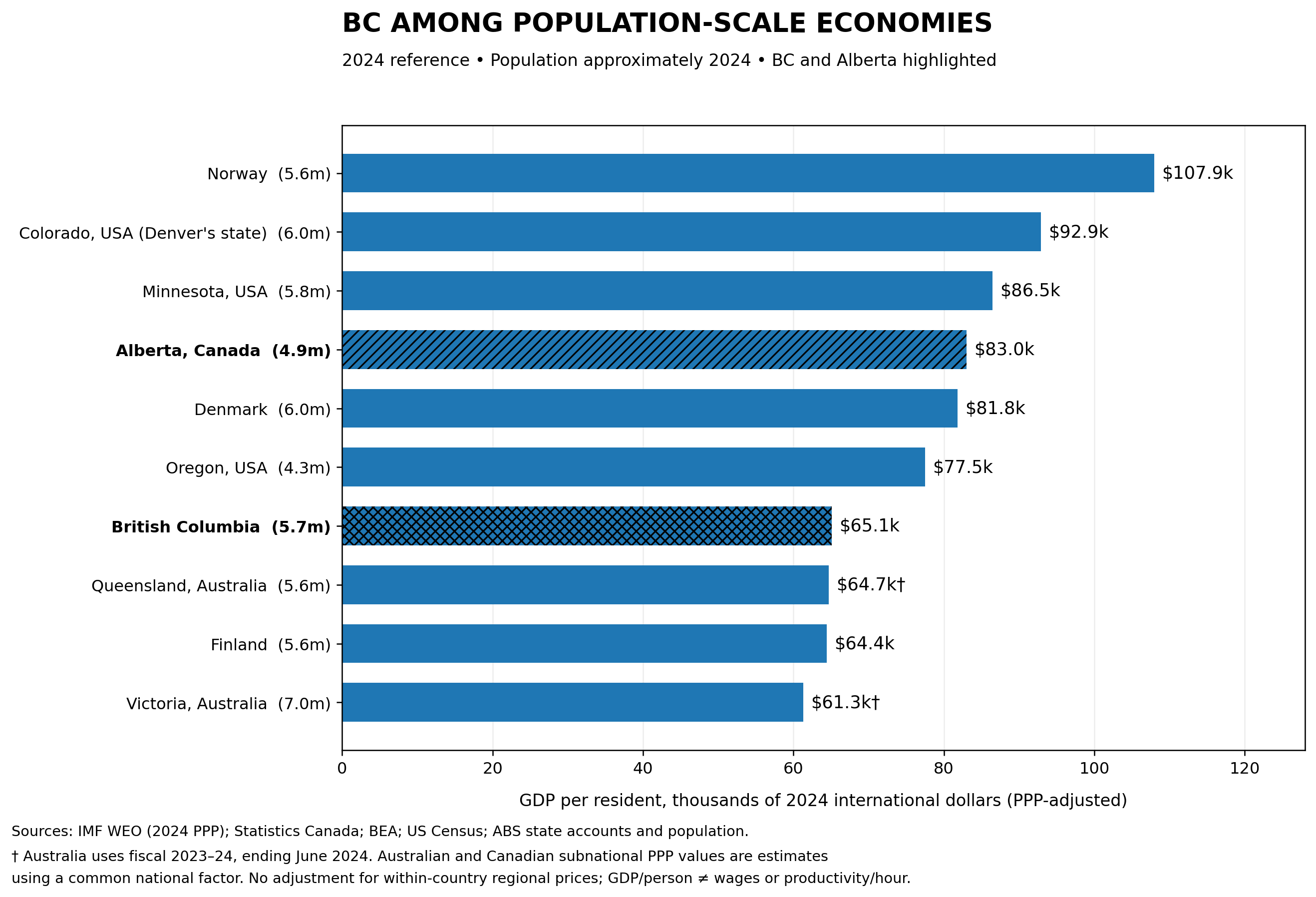
Using estimated GDP per resident adjusted for purchasing power, Norway sits around $107,900, Colorado $92,900 and Alberta $83,000. These figures are expressed in 2024 international dollars (Int$), a standardized purchasing-power measure benchmarked against the US dollar.
BC comes in at the bottom of the pack at roughly $65,100. Nothing raising more taxes won’t fix, right Mr. Eby?
GDP per resident isn’t take-home pay or affordability. Resource-rich Norway and Alberta also have different economic structures. But that’s the point. What are other jurisdictions doing with their advantages, and why aren’t we demanding that Victoria and Ottawa learn from them and apply them towards resource rich British Columbia? The fact that it’s taboo to even mention resource development in B.C. is part of the problem. Seldom are we having nuanced conversations around this, it typically devolves into kicking and screaming from both sides of the political spectrum.
Growth Without Prosperity
I swear we’ve been discussing versions of the same problems forever. Go as far back as the 1970’s and you’ll find politicians talking about housing failing to keep up with population growth. More than half a century later, we are still having the same conversations?
At what point does identifying the same problems without a credible long-term vision or measurable results become little more than political bullshit?
Now of course, BC’s total GDP can rise simply because more people live here. But if productivity, wages and quality of life aren’t improving, who’s actually getting ahead? If our economic model relies on continuously adding people (cue the massive wave of immigration) to keep headline GDP climbing, it starts to resemble a pyramid scheme more than genuine economic growth.
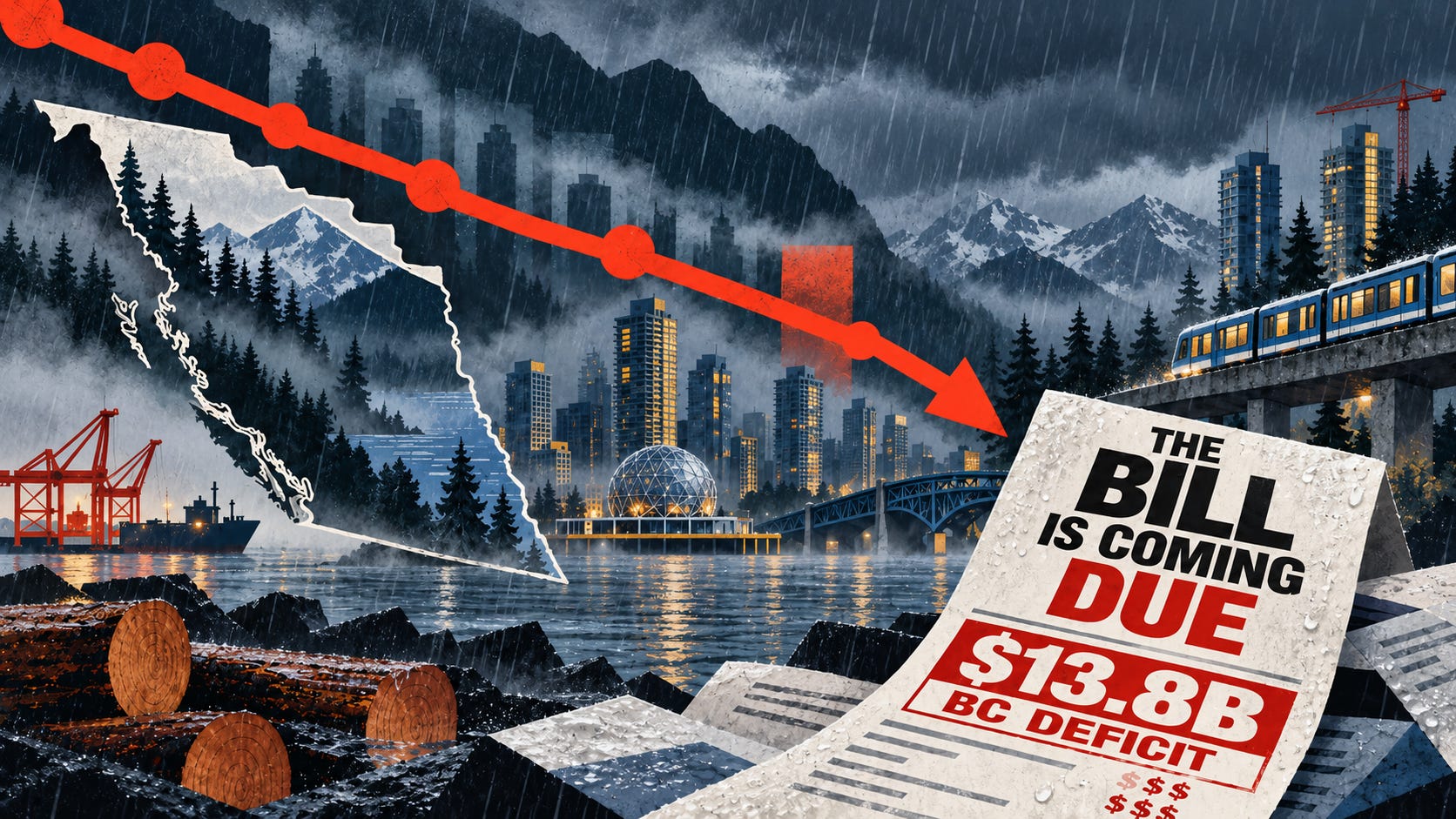
So far the province’s September First Quarterly Report for 2026–27 forecasts a $13.8-billion deficit and real economic growth of just 0.9% in 2026. In reading that, only one word comes to mind, pathetic.
But wait, that’s only the first year. The updated forecasts also project deficits of $12.7 billion in 2027–28 and $12 billion in 2028–29. To anyone, this should be alarming. Yet, barely a whisper from most of the journalists in this Province.
That’s $38.5 billion in combined projected deficits over three years.
What exactly are we getting in return? In short, very little. But we are getting more taxes to offset the incompetence of this current government.
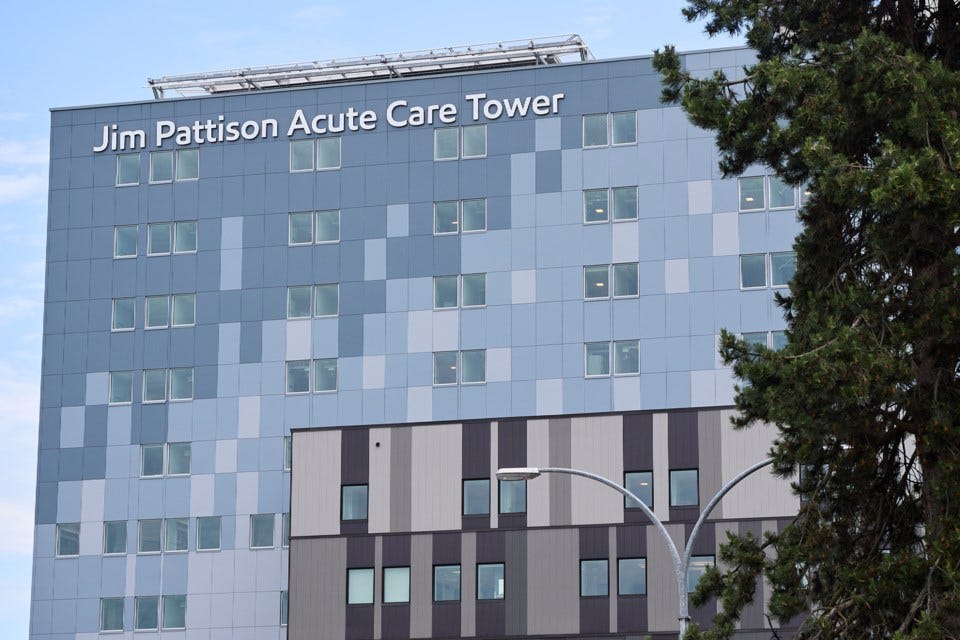
Of course there are genuine projects underway. The Royal Columbian Hospital’s acute-care tower opened in May, and Budget 2026 does plan for $37.7 billion in taxpayer-supported capital spending over three years. Yet the quarterly report cut this year’s capital-spending forecast by $716 million because of project-timing changes, while Surrey’s new hospital and cancer centre is targeting 2030 completion. Where are the transparent delivery dates, costs and outcomes?
And don’t get me started on the nearly $1.5-billion natural-gas royalty forecasting error. Four calculation mistakes, including a currency-conversion blunder, overstated projected revenue by $1.46 billion over five years. That’s a forecast error, not money spent, but how does it make it through the budget process? (Canadian Press)
To further add insult to injury, Moody’s, S&P and Morningstar DBRS all downgraded BC in 2026. These ratings can affect the cost of new borrowing, and Moody’s projects debt-interest costs rising from 4.7% of government revenue in 2025–26 to 7.9% by 2028–29. This is another direct result of a poorly run government.
I’m not against borrowing to build the future. But show us what it’s building. Otherwise, more of tomorrow’s revenue goes toward servicing yesterday’s debt.
That’s Victoria’s record to defend. But our economic problem runs deeper than the provincial books. Both Victoria and Ottawa need to explain why we aren’t creating more high-value businesses, attracting greater investment and building an economy capable of paying for the future we’re promising.
And the warning signs aren’t limited to government finances. According to Startup Genome, Vancouver has slipped from 30th worldwide in 2023 to tied for 40th in 2026 in its global startup ecosystem rankings. Methodologies evolve, but the direction should concern us. We have extraordinary talent in AI, biotechnology, cleantech and advanced manufacturing, yet other jurisdictions are aggressively pursuing investment while we continue twiddling our thumbs and espousing political rhetoric.
Are Victoria and Ottawa doing enough to help commercialize our discoveries, finance BC companies and retain more intellectual property here? Because we certainly aren’t going to borrow or tax our way to prosperity without strengthening the economy.
Turning Natural Wealth Into Public Wealth
Here’s an idea I think deserves serious exploration.
BC is sitting on a goldmine for the AI, electrification and advanced-manufacturing economies. I know AI scares people, and it should, as it’s currently unregulated, but from an economic standpoint, it’s here and it isn’t going anywhere.
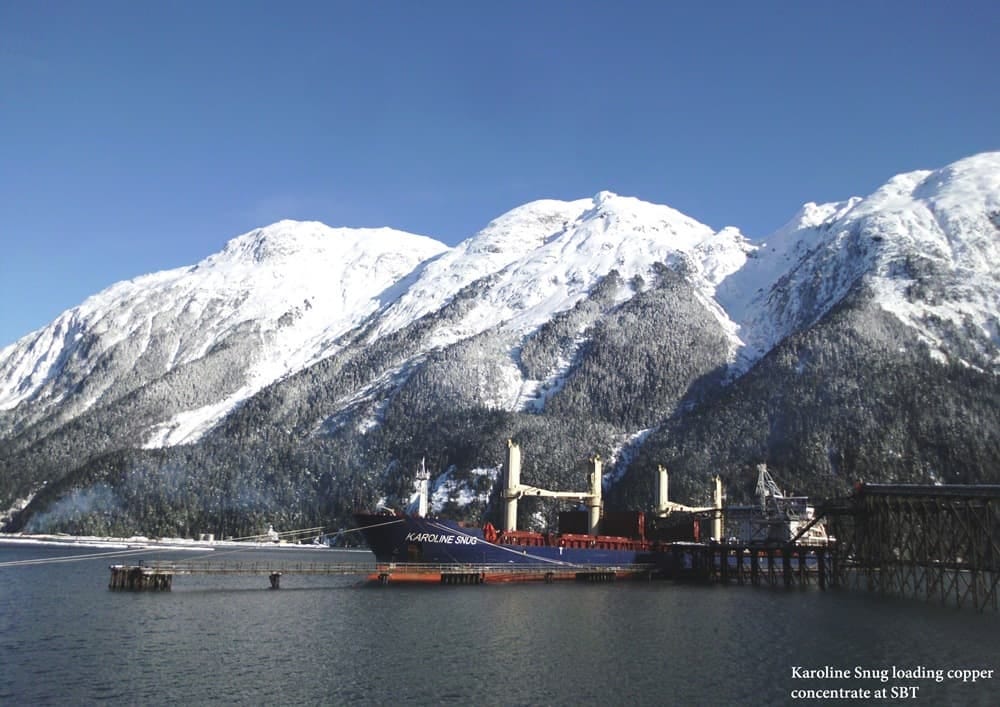
According to the province’s September 2026 mining update, BC produces or has the potential to produce 22 of Canada’s 34 designated critical minerals. We are Canada’s largest copper producer, accounting for approximately 48% of national mined production in 2024, and its only producer of molybdenum, a metal with industrial and emerging advanced-semiconductor applications.
Exploration isn’t exactly standing still. According to EY, mineral and coal exploration and evaluation spending reached a record $751 million in 2025, up 36% year over year.
But here’s what frustrates me. Natural Resources Canada acknowledges that almost all the copper mined in BC is exported overseas for smelting and refining. Yes, we already have important domestic processing operations, including Trail, and Ottawa has been exploring additional Western Canadian copper-processing capacity.
But why are we still exporting so much of the material while other economies capture the downstream opportunities? Where is the larger strategy for processing, refining, advanced materials and manufacturing? And why is it taking so long to realize that we need to get moving on this?
We’re literally sitting on a goldmine, and I’m tired of watching so much of the additional economic value get created somewhere else. British Columbian’s deserve better leadership, not ones obsessed with staying in power.
Responsible development must protect the environment, but a responsible government can’t use environmental concerns as a scapegoat to stall growth; there must be a balance. The province’s Look West strategy already identifies growth opportunities. Why not take a defined share of future resource revenues and turn them into permanent public wealth?
This brings me to Norway. Norway’s Government Pension Fund Global invests petroleum wealth for future generations, guided by a framework generally based on an expected 3% annual real return. Now BC isn’t Norway, and our deficits need addressing first. But why couldn’t we eventually establish an independently governed BC Prosperity Fund, protected from politicians treating its principal as another operating account?
Imagine what a disciplined share of its eventual returns, working alongside existing budgets, federal partnerships and private investment, could help build:
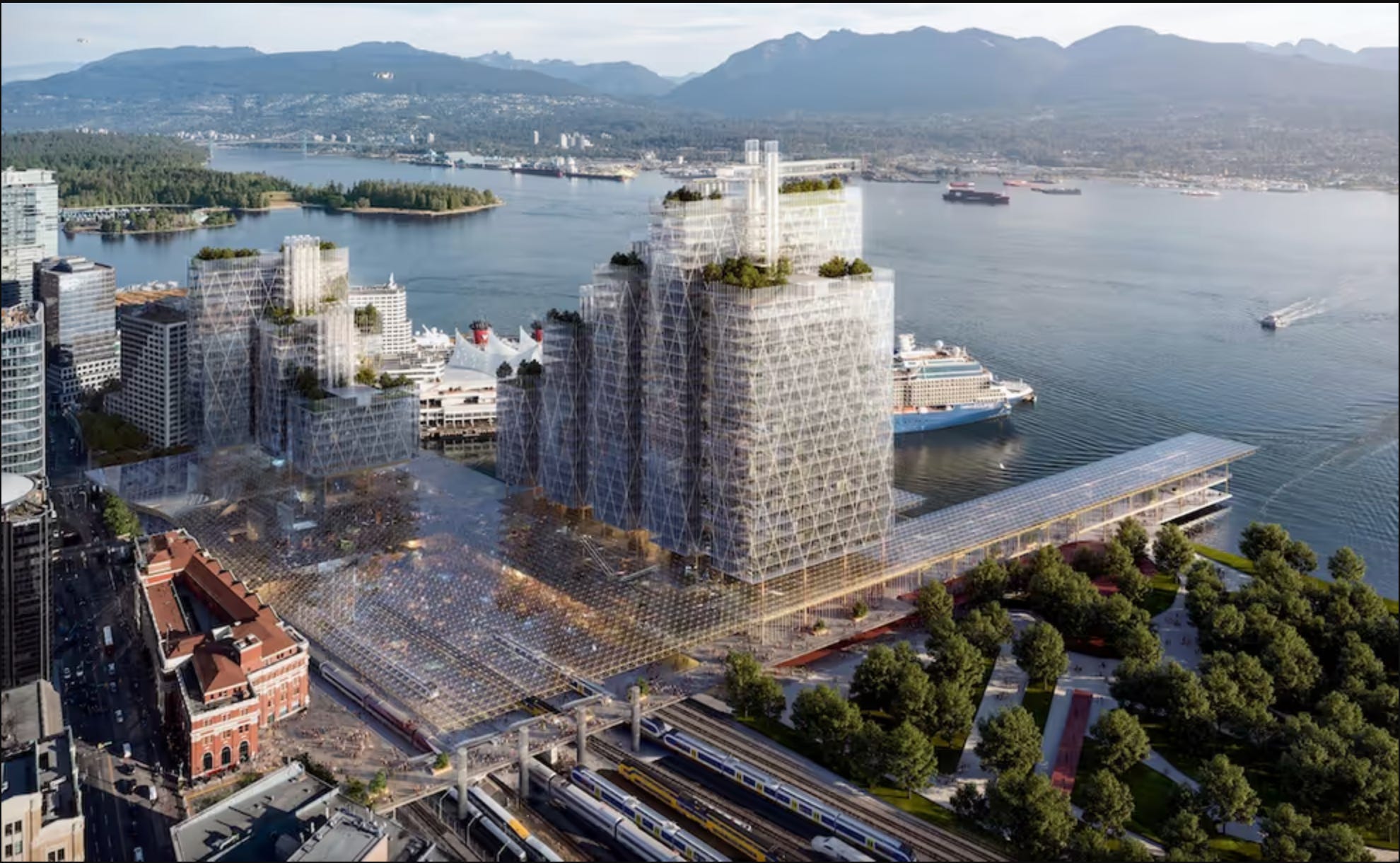
Transportation: More rapid transit and regional bus service, an expanded Waterfront Station, better passenger rail to the Fraser Valley and Interior, and a serious BC–Ottawa partnership on proposed Cascadia High-Speed Rail, with the ambition of linking downtown Vancouver, Seattle and Portland. Why shouldn’t we think at that scale?
Venture capital: Independently managed capital to help BC companies commercialize research, attract private co-investment, scale and retain local ownership. Not politicians picking their favourite founders; a serious effort to grow the next generation of BC-headquartered businesses. It’s time for an Innovation Hub, one that Frontier Collective has touted for years.
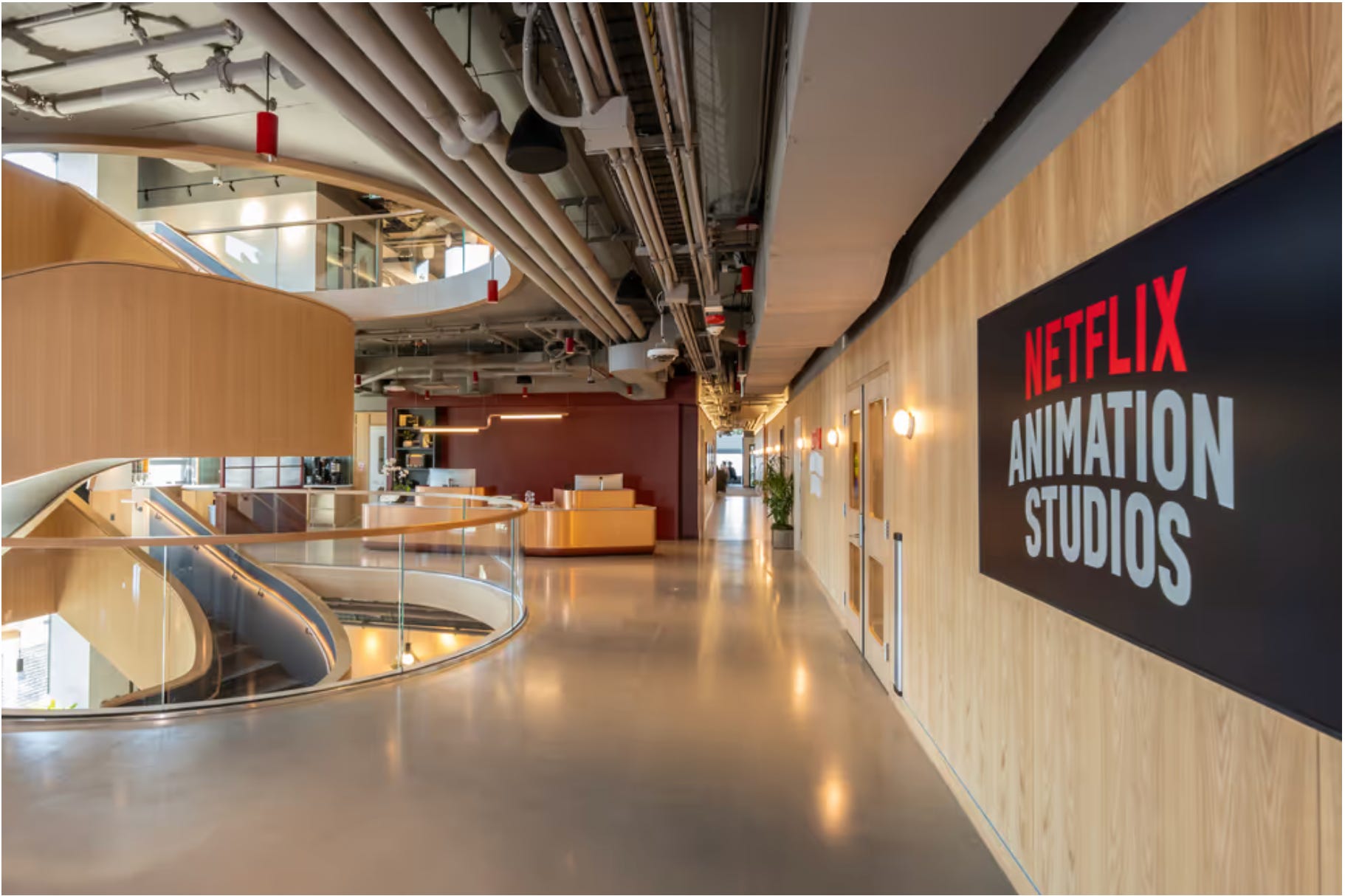
Creative intellectual property: A BC Creative IP Fund for locally developed film, TV, animation, gaming and music. We’ve spent decades supplying the talent that makes other people’s productions. Why shouldn’t we own more of the underlying stories, franchises and commercial rights, and share in their long-term value?
A railway, a startup and a television franchise aren’t the same kind of investment. Each would require suitable funding structures, independent expertise and transparent performance measures. The point isn’t another government slush fund. It’s converting today’s natural wealth into tomorrow’s infrastructure, companies and intellectual property. Imagine what that could mean by 2050. I know it would mean more high paying jobs, and opportunities for the youth. In another word, it means hope. Hope for a Province with so very little right now because we have little to no faith in our provincial leadership.
A City Worth Living In
Prosperity isn’t only GDP. It’s also what governments deliver with the money they collect, and the quality of life residents experience.
Take homelessness, addiction and mental-health services. BC’s 2023 budget committed $1.5 billion over three years toward expanded homelessness and encampment responses. Budget 2026 added $131 million over three years for intensive mental-health and addiction treatment. These were broad program commitments, not simply payments to non-profits. But where are the clearly reported outcomes? How many people are receiving effective treatment or moving into stable housing?
We need compassion, treatment, recovery and safe communities together. But getting those basics right can’t be the entirety of our ambition. If we’re talking about what prosperity should look like in 2050, surely it includes creating a province people are genuinely excited to live in, rather than one where we’re simply getting better at managing crises.
And this is where culture belongs in the economic conversation.
Culture isn’t a luxury, or something we should only remember when there’s money left over. Music, festivals, restaurants, film, professional sports and public spaces create jobs, attract visitors and investment, and give people a reason to stay. Why aren’t Victoria and Ottawa treating Vancouver’s cultural potential as a serious economic opportunity? Let’s secure the Whitecaps’ future, examine the possibility of Major League Baseball, support live venues and develop a recognizable calendar of signature events with community producers and private partners. Let’s bring more locally created wealth into cultural endowments.
Owning more BC creative IP is one goal. Building a city worth experiencing is another. Both should be part of prosperity.
The Next 25 Years
I’ve worked across media, business, hospitality and community initiatives long enough to know BC doesn’t lack talented people. Our conversations are just siloed: tech talks to tech, real estate to real estate, culture fights for scraps, and Victoria and Ottawa too often consult the usual suspects.
But we should challenge ourselves, too. We’ve become exceptionally good at saying no. We want prosperity but sometimes treat entrepreneurship, development and investment as suspicious. Not every project deserves approval, of course. But surely our vision can’t stop at finding another reason to oppose something. The lack of conviction amounts a culture of “No”, a culture we have perfected here.
The media rewards conflict. Business leaders complain without always helping shape solutions. Voters defend bad decisions when they’re made by their preferred party. I’m not above that criticism either.
Why not bring founders, researchers, investors, cultural producers and community leaders into a serious 2050 conversation, with projects and measurable milestones instead of another photo-op committee?
I want higher real wages, more BC-headquartered companies, reliable infrastructure, safer communities and a richer cultural life. Victoria and Ottawa have the economic tools. We have a responsibility to demand that they use them intelligently, and to support worthwhile ambition when they do.
What does British Columbia want to be by 2050? Who is prepared to build it? And at what point does accepting mediocrity become a choice we’re making ourselves?