


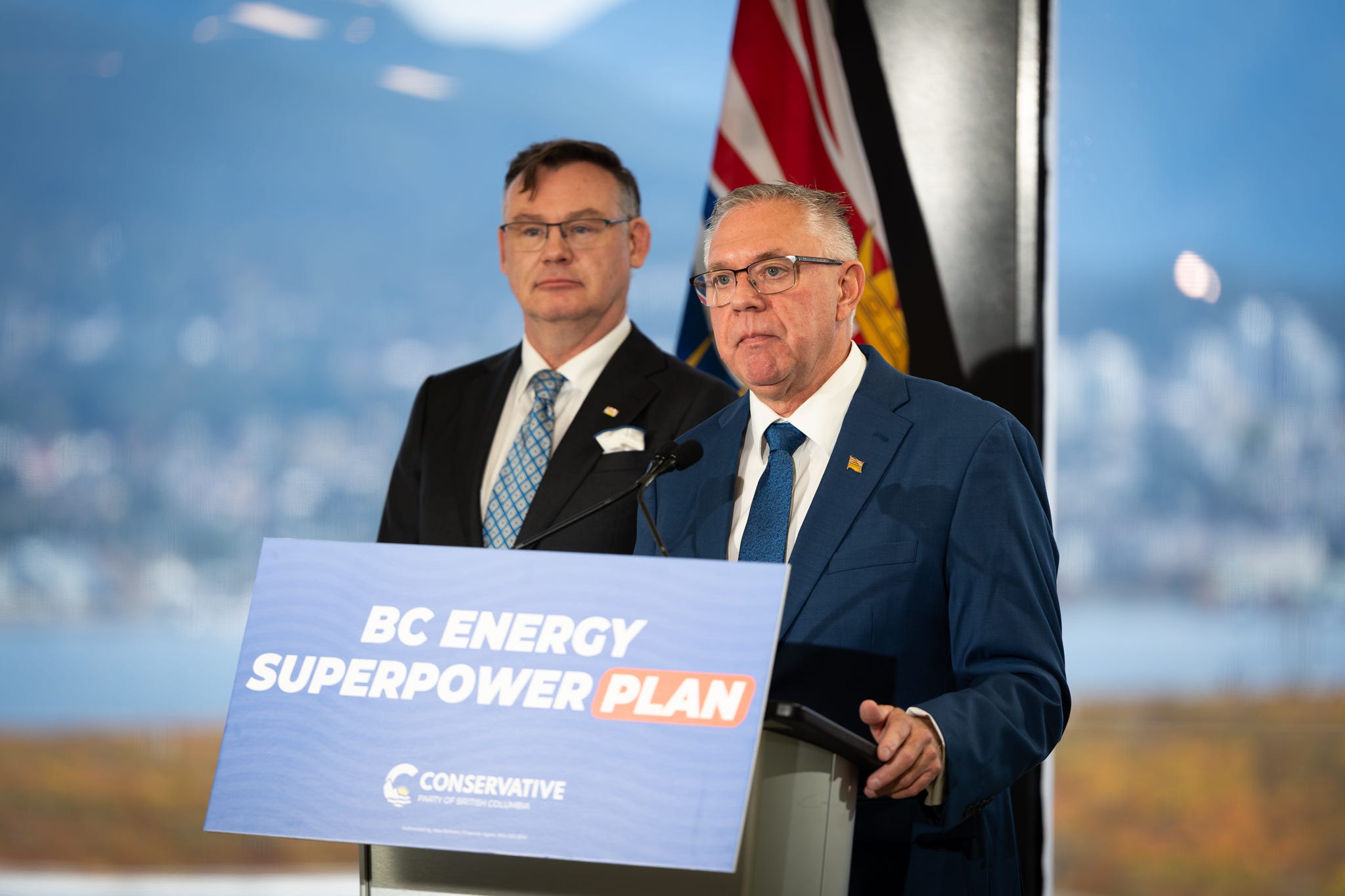
British Columbia has voted for change.
The Conservative Party of British Columbia, led by Lorne Doerkson, has won the October 24 provincial election, ending nine years of NDP government that was characterized by a lack of humility and hypocrisy over David Eby’s tenure.
For a party that was engulfed in a leadership crisis only weeks earlier, the result is an extraordinary political reversal.
Here are five issues that will help define the next government’s agenda.
1. Can the Conservatives get B.C.’s deficit under control?
British Columbia’s fiscal situation may be the single greatest challenge facing its next government.
According to the province’s September financial update, B.C. is forecasting a $13.8-billion deficit for the 2026–27 fiscal year. That comes after several years of significant operating deficits.
Looking at the province’s financial history puts the challenge into perspective.
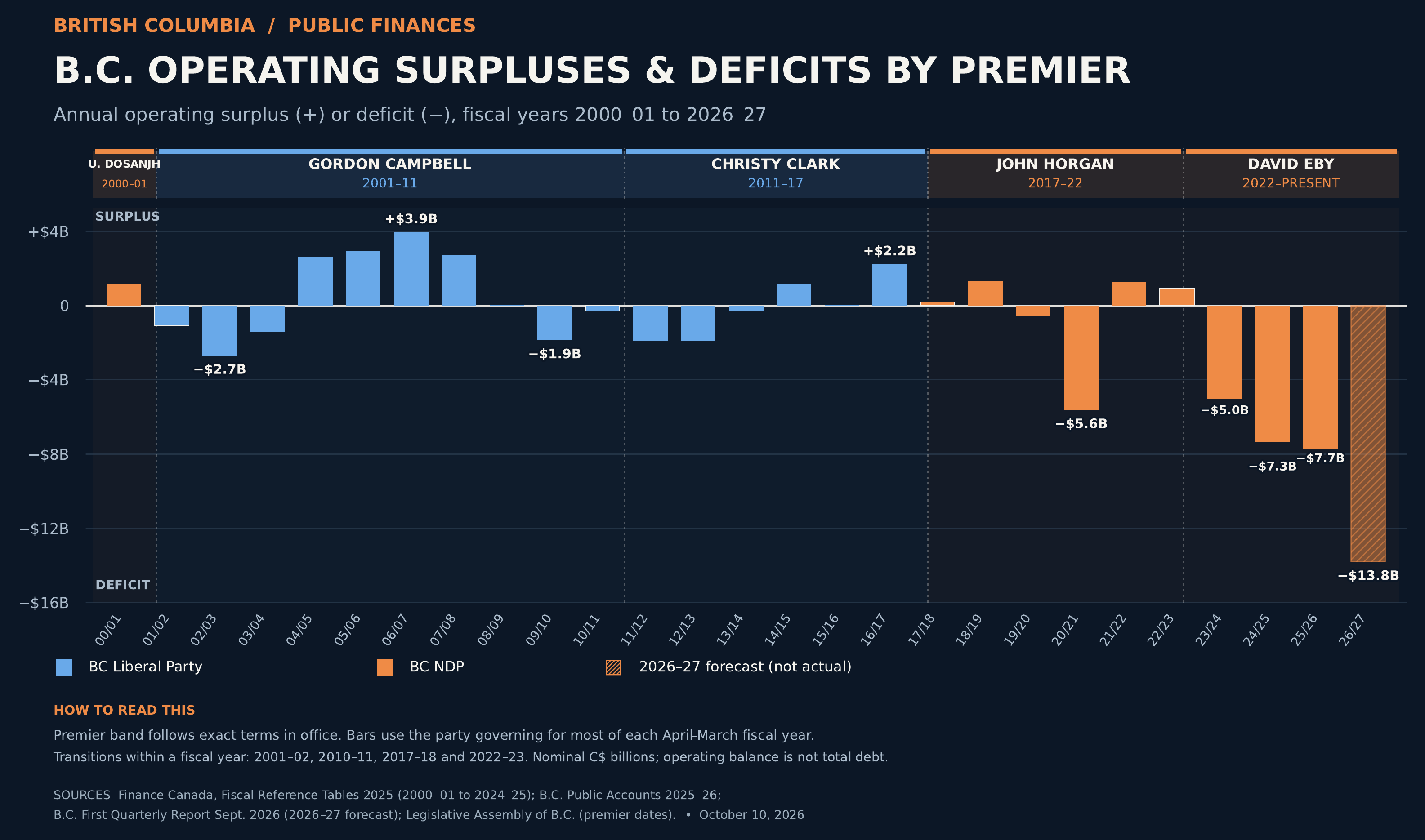
Under Gordon Campbell’s BC Liberal government, the province recorded a $3.94-billion operating surplus in 2006–07. However, that government also ran deficits during its early years and following the global financial crisis.
Under David Eby, the operating deficit has grown considerably, reaching a projected $13.8 billion in the current fiscal year. And there is no global financial crisis to lay blame on this time.
These figures are in nominal dollars and do not account for inflation, changes in population or the size of the economy. Nevertheless, they demonstrate how the province’s fiscal position has shifted over time.
The Conservatives have promised to grow the economy, reduce administrative spending and cut taxes. Their election platform anticipates more than $11 billion in tax relief and additional government revenue from stronger economic growth.
However, their own plan still projects a deficit of approximately $10.8 billion in 2029–30, with no balanced budget during the four-year outlook.
The NDP has questioned the Conservatives’ economic growth assumptions and warned that spending restraint could affect public services.
The challenge is clear: can the next government stimulate investment, improve public services and begin repairing the province’s finances at the same time?
Vancouver has more stories worth telling.
Get the next one in your inbox. Always free.
2. What does a Conservative government mean for health care?
Health care was one of the biggest issues of the campaign, in part due to the fact that many British Columbians are struggling to find family doctors or face lengthy waits for treatment.
The Conservatives have promised to maintain public health care funding while recruiting more doctors and nurses. Their commitments include a $50-million emergency fund to support rural medical practices, expanded medical training and faster recognition of international credentials.
Doerkson has also promised an expert commission within his first 100 days to examine ways of reducing wait times. The party has proposed publicly funded treatment at private facilities when surgical wait-time benchmarks are exceeded.
The Conservatives insist that health care will remain universal and publicly funded. Many critics, however, have raised concerns that increasing private delivery could draw staff away from public hospitals.
For British Columbians, the real test will be whether these changes translate into faster access to care.
Can more residents find a family doctor? Will emergency departments remain open? Can surgical wait times fall without placing additional financial pressure on an already strained health care system?
3. What happens to Metro Vancouver’s major transportation projects?
The next government will inherit billions of dollars in transportation projects already underway, with Metro Vancouver among the fastest-growing regions in the country.
The Broadway Subway extension remains on track to open in 2027, while the 16-kilometre Surrey–Langley SkyTrain extension is expected to begin service in late 2029.
The Conservatives have pledged to expand rapid transit where population growth and ridership justify it. More specifically, they have promised to work with Ottawa to extend SkyTrain south along King George Boulevard to Newton Town Centre.
They have also proposed replacing the George Massey Tunnel with a new 10-lane bridge, abandoning the NDP’s eight-lane replacement tunnel plan.
These commitments raise important questions about cost, timelines and priorities.
Will the new government maintain the momentum behind projects already under construction? How quickly could a Newton extension move from a campaign promise into an approved, funded project?
And beyond the projects already announced, what happens to longer-term priorities such as extending the Broadway Subway to UBC and improving rapid transit to the North Shore?
Vancouver needs more than new commitments. It needs reliable infrastructure delivery that keeps pace with population growth.
4. Can the Conservatives repeal DRIPA and restore investor confidence?
One of the most consequential policy changes could involve British Columbia’s Declaration on the Rights of Indigenous Peoples Act, commonly known as DRIPA.
The legislation was passed unanimously in 2019, establishing a framework to align provincial laws with the United Nations Declaration on the Rights of Indigenous Peoples.
However, the legislation has become increasingly contentious, particularly following court decisions examining its legal implications.
The Conservatives have explicitly promised to repeal DRIPA and Section 8.1 of the Interpretation Act. They argue that the current framework has created uncertainty for businesses, investors and resource development.
If the Conservatives secure a legislative majority, they could move quickly to introduce repeal legislation. But removing DRIPA would not eliminate the constitutional rights of First Nations or the Crown’s duty to consult.
Indigenous leaders have also strongly opposed previous proposals to suspend or amend the legislation, warning that unilateral changes could create further conflict and litigation.
That presents the next government with a complicated challenge.
Investors want clear rules, predictable permitting timelines and confidence that approved projects can proceed. First Nations want their rights respected and meaningful participation in decisions affecting their territories.
A change in legislation alone will not guarantee either outcome.
Can the Conservatives establish a more predictable investment environment while building durable partnerships with First Nations?
For a province seeking to attract major capital investment, the answer could shape B.C.’s economic future for years.
5. Will Vancouver’s new mayor and the province find common ground on public safety?
Perhaps the most interesting political relationship to emerge from October’s elections will be between Vancouver’s newly elected mayor, Pete Fry, and incoming Conservative premier Lorne Doerkson.
Fry’s election victory on October 17 marked a significant change in Vancouver politics. Yet voters also delivered a clear message on two public safety questions.
According to the City of Vancouver’s official results, 68.6% of valid votes on the first plebiscite supported strengthening city laws against open-air hard drug use in public spaces.
A further 68.0% supported asking the province to establish a secure medical facility offering voluntary care and more than 100 involuntary care beds for people with severe addictions or mental health disorders who pose serious risks.
Both questions were non-binding. Nevertheless, the results provide a clear indication of what participating voters want addressed.
Fry has dismissed the plebiscites as a political gimmick, although he has also said he does not want open-air drug use continuing on Vancouver’s streets. His preferred approach involves directing people toward supervised consumption facilities, shelters and other appropriate locations.
The Conservatives have promised stronger enforcement against public drug use, alongside expanded intervention and treatment.
The two approaches are not identical. Yet both acknowledge that the current situation demands attention.
The question now is whether Fry and a Conservative provincial government can establish a working relationship that respects Vancouver’s municipal responsibilities while addressing the concerns expressed by voters.
Will the mayor pursue stronger local bylaws? Will the province fund additional secure treatment capacity? And can both governments agree on practical measures to reduce open-air drug use without abandoning people who need medical care?
For residents and businesses dealing with the effects of the toxic drug crisis, results will matter more than political differences.
The election is over. The harder work begins.
The Conservatives have formed a majority government following one of the most turbulent political periods in recent B.C. history.
But the scale of the challenges facing the province is considerable.
British Columbia needs better health care access, stronger public finances, transportation infrastructure that matches its growth and a regulatory environment that can attract investment while respecting Indigenous rights.
Meanwhile, Vancouver has a new municipal government with its own priorities and a population expecting action on affordability, housing and public safety.
An election changes who makes the decisions. It does not automatically resolve the problems.
The next four years will reveal how much of the Conservatives’ agenda can be translated into measurable progress.
Vancouver has more stories worth telling.
Get the next one in your inbox. Always free.